
Trigger warnings: This play references suicide, mental illness and prescription drug use. Please take care when reading this review.
It is not often one encounters art so powerfully raw that it can trigger you into an ugly cry. Kendall Feaver’s The Almighty Sometimes was that work for me.
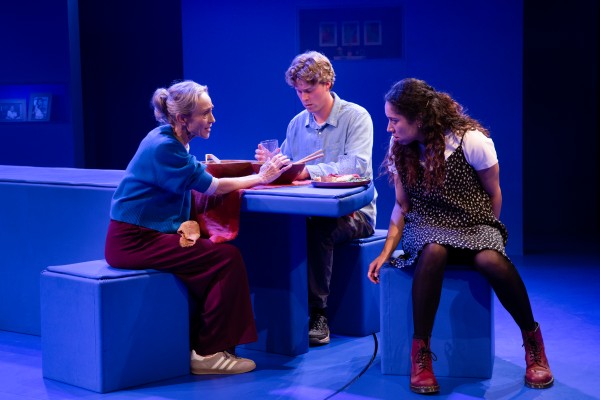
Hyperrealistic in its portrayal of the transition from childhood to adult mental healthcare, the play delves into the choices we make – as parents, as partners, as patients, and even as healthcare providers – and the oftentimes difficult (and sometimes necessary) effects of said choices.
Without giving too much away, I daresay I consider myself somewhat versed in this topic. I have been both the parent and the daughter in this scenario. Feaver has managed to nudge every single nerve-ending and deep-seated trauma response as only someone who has lived this reality could.
The play follows Anna (‘Ana Ika), who has been medicated for a mental health diagnosis since she was 11. She lives with her caring (and perhaps even a touch overprotective) mother Renee (Alison van Reeken). Newly 18, she is facing change – possibly attending uni, a new boyfriend Oliver (Harry Gilchrist), and embarking seriously on her writing career. After all, she came across the notebooks she’d written in as a child, and they were brilliant. Advanced, even, if a bit dark, but still promising. If only she could write something now. Convinced the medication she has been on since age 11 is dulling her ability, she goes off them cold turkey, leading her mental state to spiral dangerously. As she lashes out against everyone around her, her close circle is forced to confront the limits of their love, and to grapple hard questions with no easy answers: Whose life is it, anyway? And at what cost, stability?
Amy Mathews shone in her role as paediatric psychiatrist, Dr Vivienne, trying desperately to maintain the balance and sensitivity between healthcare professional, safe space, and one of the chosen few in Anna’s life whom she trusts and even thinks of as a “friend”, whether or not it was appropriate. ‘Ana Ika was brilliant as Dr Vivienne’s troubled patient, portraying the transition between stable Anna to spiraling Anna with a subtlety and authenticity that was exceptional. The standout for me, however, was Alison van Reeken, who played Anna’s mother Renee. Perhaps it was a shared kinship between Renee and I over our circumstances – trying to grasp on to the tenuous hold on Anna’s wellness, without usurping her autonomy, and facing the reality of the impossibility of it all.
One particular scene that has stayed with me is when Anna, Oliver and Renee are having dinner, post cold-turkey, and Anna is on the verge of a meltdown. While Renee talks calmly, ignoring the aggression and doing her best to de-escalate the situation – obviously something she must have done multiple times before – Oliver is outraged that Renee has let Anna talk to her like that. The bleakness of knowing that people like Anna will be misunderstood by most in the world – and the realisation that nobody will care for them like you as a parent – is truly isolating.
The clever revolving stage, and the impeccable sound and lighting provided the perfect backdrop to the actors’ seamless storytelling. The depiction of the sameness of the days post-hospitalisation after the attempted suicide was very effective with Renee’s pacing around Anna’s bed while the stage was turning. The set transformed easily from home to clinical setting to hospital bed with very little props. The graphics projected to the side of the stage helped create a visual extension for what words alone could not portray. Also, I might be projecting, but I felt the lighting and sound even simulated the side effects Anna might have felt from the withdrawal of her prescription drugs.
In essence, all these elements combined to create the perfect storm of an intimate, emotionally-charged, powerfully raw and heartbreakingly authentic snapshot into the reality of mental healthcare in Australia. The Almighty Sometimes is not an easy watch. But then, the most important stories rarely are. Feaver has written a play that does not offer comfort – only recognition. And sometimes that is enough.