
Ask anyone about Chernobyl and most identify it as one of the world’s most disastrous nuclear sites.
Ask someone about Wittenoom and you’ll most likely get… Witten who?
Yet, Wittenoom, part of Banjima country, is the worst contaminated site in the Southern Hemisphere. The level of asbestos contamination is so extreme that Wittenoom was removed as an official town in 2007.
Yurlu | Country is set to raise awareness of this catastrophic predicament.
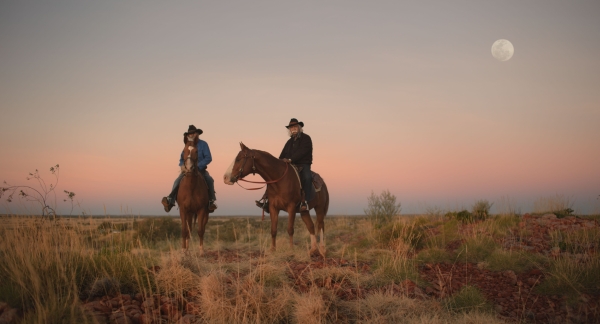
The movie, a Finalist for the 70th Walkley Documentary Award, is helmed by Australian director Yaara Bou Melham.
Melham is a journalist and multi award winning documentary filmmaker. In fact, she is a seasoned Walkley Award recipient with five awards to her name.
So walking in to Yurlu | Country, you know it will not be your run of the mill, factual documentary. Instead of merely spouting facts, It follows Banjima Elder Maitland Parker, weaving his experience into the film. It also juxtaposes archival footage throughout the movie, adding contextual depth to the big picture.
When we meet Parker, we see a proud Banjima Elder. He is defiantly battling mesothelioma, a rare cancer that is associated with asbestos exposure. He was a man on borrowed time, on his final sprint to heal his nation.
On first impression, one could mistake Yurlu | Country for a travelogue. The area, with its rusty red ridges, creased gorges and waterfalls could rival the Grand Canyon. However, as the camera pans into the scenery, we can see just how extensive the contamination is. Asbestos tailings form giant, almost tar-like blankets over the landscape. As beautiful as the area is, these swathes of toxicity have deemed it a wasteland.
This is a stark contrast to the Wittenoom during the asbestos boom. Commentators hail late magnate Lang Hancock for single handedly developing the region. An advertisement glows with praise for the idyllic town of Wittenoom. It sings about how perfect it is for families with the amenities of the big city.
But behind this picture perfect sales pitch, Yurlu | Country exposes the dark side of the industry. In particular, it highlights just how ill-regarded the local Aboriginal communities were then… and now.
There are throwbacks to the constant implications that the area was uncivilised until the arrival of the mining industry. The narrative hinged on how the geological formations meant nothing to wandering tribes, even though rock paintings in rare yellow ochre exist on these very structures.
And tellingly, an old map of Western Australia barely has place names. Instead it lists: sheep, gold, mica and oil.
An archived television interview with Lang Hancock couldn’t be any clearer. I audibly gasped hearing not just his racist comments but his casualness in verbalising them.
Which probably explains why the area was abandoned without any consideration for the health of the community it left behind.
Even though Parker never worked on the mines, he contracted mesothelioma because he worked in the national park nearby. Yet as children, members of his community would walk these now exluded land zones, picking up asbestos and chewing on them. What of them?
Beyond the obvious health concerns, Parker makes it abundantly clear that the area is sacred to the Banjima Nation.
Mulga Downs, in particular, is of great significance as many of the Banjima worked and lived there. By virtue of the community that established itself there, the land is home to sacred sites including a birthing tree that’s part of “women’s business”. The community were not able to access Mulga Downs for years until very recently. when they were granted special permission for cultural purposes.
It is a small win. It is a shame that Parker never got to see that day, after he spent over twenty years begging for help. Additionally, there is still so much to do to heal the nation, both physically and spiritually.
This film is the first step in that. It serves as a fine legacy for a relentless champion and spotlights the cause he was so passionate about.
I know that it will inspire a new generation of advocates to pursue remediation for a land that has been neglected for far too long.
Yurlu | Country: Healing ‘Poison Country’ opens 13th November with special screenings from 9th November. Check out the Yurlu Country website to find out how you can help.