
I’m not normally someone to reach out for period dramas. I find them tedious to follow and the courtly ideals they espouse just don’t do it for me.
So when I heard that Jimmy Carr was taking a stab at besmirching it by way of parody, I had to grab the popcorn.
Jimmy Carr’s humour sometimes borders the edges of the offensive and taboo but not because he needs to vent some deep seated frustration. On the contrary, these controversial statements are just that – factual observations of the topic at hand.
So it is no surprise that his screenwriting debut, Fackham Hall, mirrors his style of comedy.
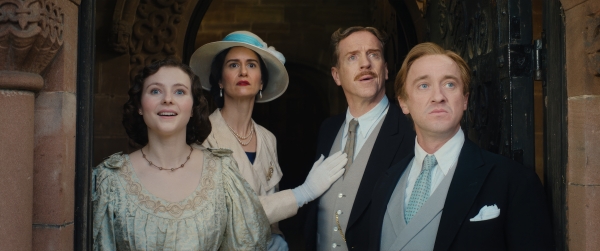
When we first enter Fackham Hall, the subtitle of its wrought iron sign is “Incestus Ad Infinitum”.
But don’t be too quick to clutch those pearls.
This running gag forms the foundation of the plotline as it is a reflection of the society the characters live in. It was not uncommon for artistocrats in 1930s England to marry their relatives to keep the wealth in the family.
And this is is the woeful situation our protagonist Rose (Thomasin McKenzie) finds herself in. After her sister Poppy (Emma Laird) leaves their cousin Archibald (Tom Felton) at the altar, she is pressured by her parents to take over as bride to be, in order to keep the estate in the family.
Things get complicated when a nobody, I mean, Eric Noone enters the scene. Eric is a mere messenger who ends up stealing a job in the manor… and Rose’s heart.
And so a bawdy, battle-frought love triangle begins.
Critics have been quick to liken Fackham Hall to the Naked Gun. While I see the similarities, I would not treat them as equals.
That’s not to take away from either movie. I enjoyed both of them thoroughly but it is like comparing plums to peaches.
Yes, Fackham Hall, like The Naked Gun leans towards absurdist comedy and visual comedy. However, Fackham Hall has a stiff British upper lip, showing restraint in the visual and incorporating more clever wordplay in the script.
Additionally, the modern day references are especially funny in Fackham Hall because of its setting in 1930s, artistocratic England.
Consequently, Fackham Hall is a movies you have to really pay attention to. Otherwise, you’ll miss a random giggle nugget.
I had a chuckle seeing the signage for the local pub, The Dog and Drake.
Similary, Carr’s cameo as a minister with no sense of punctuation drew the most howls. It is especially funny given his reputation for brilliant comedic timing.
This combination of factors is what distinguishes Fackham Hall from The Naked Gun. Where The Naked Gun relies on over the top antics to generate highs of laughter, the laughs are more evenly distributed in moderate amounts in Fackham Hall.
Overall, Fackham Hall is an enjoyable watch that I wouldn’t mind rewatching just to see what I missed… and to relive the laughs I do remember from the first watch.
Fackham Hall is showing as part of the Russell Hobbs British Film Festival.