
WASO’s MACA Symphonic Series presentation of Rachmaninov’s Second Symphony started off with a bang. Quite literally. The night began with Aaron Copland’s Fanfare for the Common Man, with its characteristic crash of the tam-tam (large gong). This dramatic, highly recognisable work set the tone for the rest of the evening.
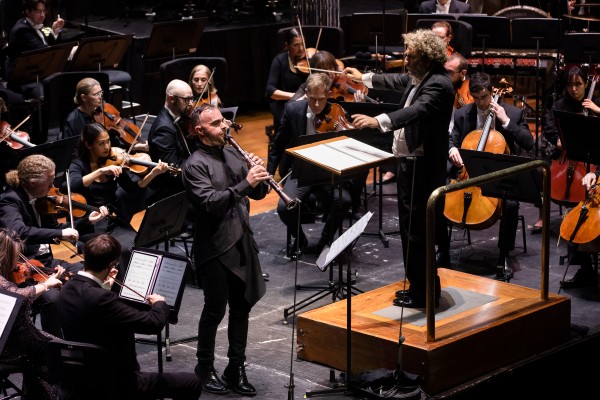
Attention procured, we were then treated to the world premiere of James Ledger’s Clarinet Concerto, written for clarinet soloist Ashley Smith and WASO. A modern masterpiece in five movements, the work is designed to push the limits of the clarinet, showcasing perfectly Smith’s virtuosic mastery of the instrument. As Smith stepped out into the auditorium in his edgy, fashion-forward interpretation of the musician’s concert black, we knew we were in for something exciting.
The first movement, Quasi una Fantasia, which translates to “in the manner of a fantasy”, is what Ledger aptly describes as a “dark canonic shimmer” – where multiple instrumental voices closely shadow and blur into one another, creating a dream-like effect. The second movement, Scala (Italian for both ‘scale’ and ‘stairs’), is suggestive of artist M.C. Escher’s “impossible” staircases, featured in his iconic artworks Relativity as well as Ascending and Descending. With its rapid arpeggios and ascending and descending melodies, it is easy to see the comparison. The third movement, Recitative, sees a mood shift into quiet reflection. Cadenza, the fourth movement, showcases Smith’s impressive technique, going from the highest register on the clarinet to the lowest. Finally, Con slancio was true to its name, pushing the orchestra “with vigour” into its thrilling climax.
The final program of the evening was Rachmaninov’s triumphant Symphony No. 2 in E minor, Op. 27. Conductor Asher Fisch took the orchestra through all four movements with nuance – from the brooding Largo, to the fast-paced Scherzo, to the harmonic Adagio with its beautiful clarinet solo, through to the final movement, with the exuberant transformation from E minor to the major key.
By the final bow, the theme of the night was certainly clear – all three works showcased the full spectrum of brass instruments in all its glory. From the majesty of Copland, to Ledger’s bold world premiere, to the rich orchestral tapestry of Rachmaninov, WASO proved once again that it knows how to start a night with a bang, and to end one with a flourish.