
I have to be completely honest: the plot of Eugene Onegin has never been a favourite of mine.
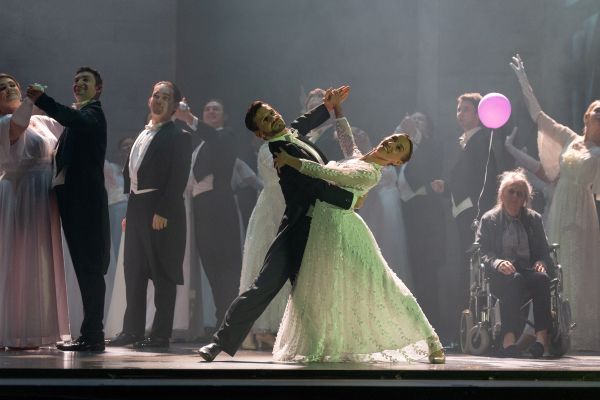
Image credit: West Beach Studio
Boy and boy’s best friend meets girl, girl falls in love with boy. Boy friendzones girl.
Boy gets dragged to a ball against his will and throws a tanty. Boy messes with best friend just because, and dances with best friend’s girlfriend ALL night.
Boy and best friend get into a fight, culminating in a good old-fashioned duel. Boy KILLS best friend, then leaves for six years in guilt and grief, and then comes back to find the girl is married to a prince for the past two years. Boy corners girl, professes his love and asks her to run away with him. Girl still loves him but refuses to mess with her marriage. Everybody is unhappy.
To sum it up, Eugene Onegin is a bit of a pain in the proverbial and a huge menace.
That said, the West Australian Opera does an amazing job. Problematic plot notwithstanding, the production itself is pretty spectacular. Northern Ireland Opera’s production, brought to life by director Cameron Menzies, does a modern take on this Tchaikovsky masterpiece. It puts a clever spin on the narrative, with the theme being one of consequences, the downfall of pride and ego, and missed opportunities. The artistic choice of putting an aged, wheelchair-bound Tatyana (Lis Hoffman) in every scene brought home this thematic interpretation perfectly – as she reminisces on the past while celebrating her birthday in a nursing home.
Visually, Niall McKeever’s set is very effective, and again, cements the theme. It brings old and new together, with medallion chairs not only used functionally on stage, but also symbolically – old medallion chairs lying in a heap as part of the backdrop, like relics of the past. The juxtaposition of 19th-century props against modern-day touches – an old AC unit on the minimalist grey walls of the backdrop – plays into the two eras portrayed: the 19th century Russia of Tatyana’s memories, and the modern-day nursing home she now finds herself in. Again this is mirrored in Gillian Lennox’s costumes, using ornate traditional 19th-century Russian garb alongside the spartan, clinical modern-day uniforms of the healthcare workers in the nursing home.
But it goes without saying that the true stars of the production are the cast. Baritone Samuel Dundas plays the titular character to perfection as the brooding bad boy of the opera. Tenor Paul O’Neill’s sensitively nuanced Lensky lands as the tragic best friend, his voice carrying every ounce of wounded pride before the fatal duel. Soprano Eleanor Lyons’ idealistic young Tatyana shines with hopeful innocence, although we know this isn’t to last. And bass-baritone Teddy Tahu Rhodes’ stately Prince Gremin brings a rich, commanding warmth to the role, making it easy to see why Tatyana chose loyalty over longing.
Special mention must go to the West Australian Symphony Orchestra, helmed by Christopher van Tuinen, whose lush reading of Tchaikovsky’s score does as much emotional heavy-lifting as any of the characters onstage. Between the cast, the staging and the music, WAO has made a compelling case for a story I’ve never much cared for – proof, perhaps, that even a menace of a plot can find its redemption in the right hands.
Eugene Onegin is showing at His Majesty’s Theatre until 15th August.