
Courtship is an intricate dance (literally) and a strategic battlefield in Christopher Hampton’s stage adaptation of Pierre Choderlos de Laclos’ scandalous 1782 novel, Les Liaisons Dangereuses. First staged by Hampton in 1985, the story was then adapted into two movies – 1988 film Dangerous Liaisons starring Glenn Close and John Malkovich, and 1999 teen reimagining Cruel Intentions with Reese Witherspoon and Ryan Phillippe. This version by the National Theatre revives the sordid tale, directed by Marianne Elliott and starring Lesley Manville and Aidan Turner.
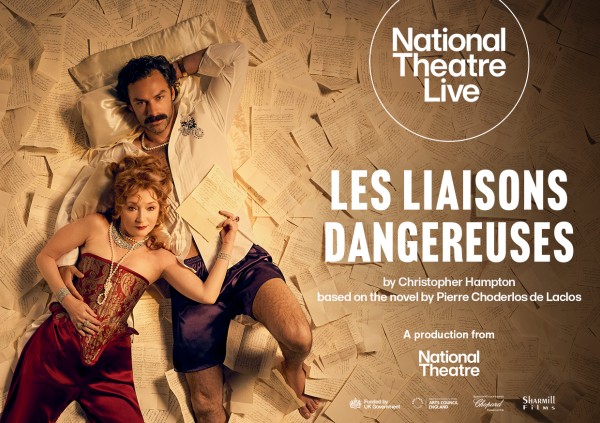
Set in pre-revolutionary France, Les Liaisons Dangereuses follows the seductive shenanigans of widowed aristocrat Marquise de Merteuil (Manville) and her ex-lover, the rakish Vicomte de Valmont (Turner). They strike a wager: Valmont is to tarnish the virtue of young ingenue Cécile de Volanges (Hannah van der Westhuysen). Simultaneously, he is challenged to seduce the pious Madame de Tourvel (Monica Barbaro). And so begins a dangerous game of deceit, betrayal and, unexpectedly, love.
As the devious Marquise, Manville is in ferocious form, relishing every barbed line with wicked delight. In her magnificent crimson gown, she bears a regal countenance, the red symbolic of the bloodsport she is engaged in. Westhuysen’s giggly Cécile is the perfect innocent, who slowly gets debauched as Valmont plays his game. However Turner’s Irish accent, roguish charm and precise, witty delivery of his lines stole the spotlight, and our hearts.
The staging of the play was cleverly executed – director Marianne Elliott’s revolving platform and rotating rooms serve as the perfect canvas for the fast pace and constant motion of the story. Dancers moved gracefully across the stage between scenes (choreographed by Tom Jackson Greaves) – symbolic of the well-choreographed game being played by the characters – every move as calculated as the one performed. The mirrored walls show the actors’ nuanced expressions from every angle – an effect that captures brilliantly on camera, giving this screening an edge over watching the play in person. Also, Elliott’s use of performers lurking behind walls during particular scenes adds extra dimension to the play’s themes of surveillance and secrecy.
Overall, this was a rather scintillating watch. Particularly satisfying was watching Valmont’s slow doomed realisation that he was actually falling in love with Tourvel. And Merteuil’s downfall at the hands of Cécile was delightfully poetic. Fitting, then, that a bloodsport should end in blood.