
Rules of Summer is based on the picture book of the same name by Shaun Tan. The book is a compendium of life rules that are accompanied by detailed, surreal illustrations. They lean heavily on warm palettes with contrasting dark tones which make the drawings seem otherworldly and in some instances, dramatic with an almost dark edge to them. If I had read the book before watching the play, I would have been skeptical of how well it would translate onstage as a children’s play.
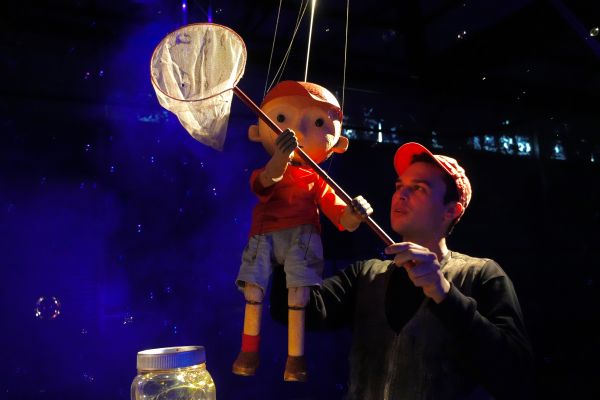
Yet Spare Parts Puppet Theatre has managed to pull it off, creating a dreamy, almost whimsical show while minimising any dark (read: scary) elements. True to the book, red and orange lighting brings warmth to the stage. Careful use of other colours provides more childlike pops of colour to downplay the moodiness of the book’s original palette. Darkness is no longer a scary thing because it is reframed as a necessity for shadow puppets to come to life onstage.
While there are moments that might lightly scare some children – just like how a flash of lightning would – these are quickly offset by the infusion of silliness by way of the actors’ expressions and the antics the characters get up to. It’s also really hard to stay scared when instead of speech, the characters use kazoos to verbalise their thoughts. Aside from upping the quirky comedic style of this performance, the kazoos convey the emotive power of language – words are unnecessary when pitch, pacing and intonation are on point. This thoughtful blend of stagecraft adapts the book into a delightful production that’s truly accessible for their target audience of children aged five upwards.
One of the big challenges of children’s theatre is getting them to actually stay focused on the production. The successful transition from book to stage provided playful sketches and an inviting setting for children to nestle into. That said, the real magnetic pull comes from Rules of Summer actually living up to its claim of being an immersive and multi-sensory experience.
The play encourages the audience to look everywhere – from the screens, to the floor and even overhead. It also encourages audience participation. Throughout the show, the line between players and audience would constantly blur. Whether it be actors engaging directly with the kids or bubbles floating off stage, teasing children out of their seats, I struggle to think of a moment when my son was not engrossed.
My favourite device is the projection box. This multi-purpose prop allowed actors to cast shadows on the exterior while also allowing scenes to play out within the screens. I loved the interior scenes as the translucent screens, in combination with the lighting, gave the scenes an almost nostalgic feel. I felt like I was a passive viewer, looking in on the characters on a television screen.
In other scenes, the structure was quickly dismantled so that the four screens could be lined up as a backdrop for more shadow play or a partition to provide a backstage area. It was such an innovative set up, which as a side bonus, quietly tells kids to think outside the box.
Another unique feature of the show is the addition of a Q & A session for the children to ask their burning questions about the show or puppetry in general. The players of the day were so patient and generous with their knowledge. In particular, rather than simply feeding the children with information, Philip Mitchell (standing in for one of the actors, and who happens to be the Artistic director of Spare Parts Puppet Theatre) did a great job of turning one question back on the kids for their input before gently guiding them to an answer. It was heartwarming to see someone at the top still interact with the audience on their level. Judging by the other actors’ interactions during this session, as well as the experience we had with the event staff, there seems to be a culture of gentle nurturing running through Spare Parts Puppet Theatre.
This is especially evident in the pre- and post-show activities that were available to the children. I wouldn’t normally mention extra curriculars to a review but these added dimension and connection to the children’s experience of the play.
Set in the spacious Centenary Pavilion at Claremont Showgrounds, event staff organised several activity zones for the children. They catered to a wide range of interests but most were puppet-focused. There was a reading rug with books and a basket of puppets – much to my husband’s misfortune as he got promptly eaten by a crocodile. There was a shadow puppet theatre, a toy theatre with various drop down characters and backdrops and even an intricate pegasus puppet which required multiple people to move its different body parts.
Giving kids the tactile experience of playing with the puppets immediately sparked an interest in the show. By allowing them access to the puppets after the show, it fanned the flames ignited by the production.
You can’t help but wonder – is Spare Parts Puppet Theatre’s motive to entertain or secretly recruit children into the world of puppetry? Whatever their intention, beyond hoping that this would be a good show, I understood why Spare Parts Puppet Theatre has thrived for over forty years. What I don’t understand is why it took me this long to experience them for myself.
Rules of Summer is playing at Centenary Pavilion at Claremont Showgrounds until 18th July. There are two shows daily (except Sundays), with a sensory-friendly, relaxed performance available on Monday, 13th July.