
The synopsis for The Birthday Trip promises an “an unflinchingly funny drama that follows three millennial couples whose relationships are thrown into disarray when they descend on a luxury Southern Highlands farm stay for a birthday weekend they’ll never forget”. Based on this description, I went in looking for a plot that would take me through high stakes drama, sexual tension and dark comedy.
Yet I didn’t leave with a strong sense of that. While there are certainly shades of these elements throughout the movie, it does not feel like a cohesive storyline.
So if you’re looking for a cut and dry narrative, The Birthday Trip is not it. It does not even offer a satisfyingly speculative conclusion – there isn’t enough for us to paint what happened next. The Birthday Trip feels unfinished, with no payoff for ninety minutes of following these couples’ stories.
Instead, The Birthday Trip is a character study into the lives of three yuppie couples and a social commentary on the deluded lives they live.
Angie, Clare and Izzy are school friends who have made a tradition of celebrating their birthdays together. On this occasion, Clare has planned a luxurious weekend getaway to Lothian Gate, a luxurious “rustic” estate that overlooks a working cattle farm.
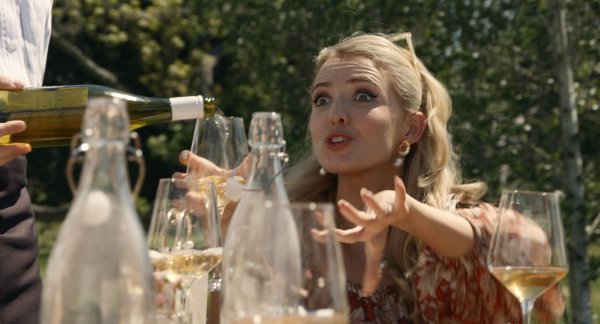
The ladies don’t come across as the perfectly gelled trio though. Izzy is the pretty blonde, who everyone gravitates to. She is clearly the unofficial group leader who also hijacks every conversation. She is especially proud of her new position as Content Manager at the ABC. Angie is the middle ground – a down to Earth documentarian who is compassionate, genuinely curious and dedicated to her craft. Clare is a sullen, arty type, silently judging everyone else while feeling the need to maintain her arty stature. While talking about Angie’s documentary, Clare mentions that there are some great painters from the region. Angie enthusiastically responds, name dropping one – Clare says she knows the name but doesn’t actually offer a name she does know.
Consequently, while the three seem connected by their artistic pursuits, their individual personality traits drive conversations that may appear genial at first glance but are sprinkled with tension and mental jibes. Throw in three partners who have never met the girls or each other before and the potential for comedy and drama is high. Indeed, much of the comedy is derived from the awkward moments where personalities are incongruent yet everyone is forced to be polite while they find their feet around each other.
There is fertile ground here, yet I found myself distracted by the shaky camera work, that is reminiscent of The Blair Witch Project. I can completely get behind this technique for the latter as the movie was framed as a gonzo piece by three students using handheld cameras while running through the darkness of a creepy forest. But employing this for day time scenes of people leisurely eating turns the movie into a jarring experience. By trying to make the movie experience feel like we’re part of a reality TV show, we’re distracted from the real substance of the film.
This was a real point of frustration because the movie has enough content to evoke strong responses in the audience. I was so invested in what was happening, yet I kept getting shaken out of my engagement. Even without considering the storylines, director James Robert Woods has created such strong character profiles that draw the audience’s curiosity.
Kudos goes to Ben Gerrard’s Mark – a business development manager in the family’s avionics company that happens to have a few military contracts up his sleeve. He is cold and calculated – from his press releases that reference family values without wanting to sound weak to his excitement at the prospect of seeing an animal being euthanised. This is a person I would not want to get on the wrong side of.
Similarly, David Quirk as the self-deprecating, completely judgy culture snob Jim was perfect. He nailed the hoity toity aura so well that I was already repulsed by his sanctimoniousness within minutes of meeting him. After apologising for being naff for playing Chopin for dinner, he does a double take when Izzy innocently (or maybe naively) comforts him by saying that there’s nothing wrong with classical magic for dinner. In a post-dinner post-mortem, he fixates on this throwaway line and rages about how boneheaded Izzy is.
And then there’s Clare, who takes insecurity to a new level. You can’t help but wonder what the real story is. Just as Jim effortlessly finds something to be condescending about, Clare pegs everything on Jim being lecherous.
The characters on their own provide enough fodder for scrutiny. But the interactions and conversations they have amongst themselves and about Felix, the “experience curator” are enough to make you do a double take.
As they enjoy a scenic lunch, Angie talks about what a dump Felix’s house is. Reactions range from flippant to cutthroat – he’s just a glorified concierge, if he wants a real house, he should get a proper job. When something happens to Felix’s house, the group is not concerned for his well-being. Instead, they’re focused on how it affects their holiday experience.
This is just a taste of the gap between the group’s worlds… and everyone else’s. It opens up the audience’s mental pathways to recognising the rich-poor gap in Woods’ movie. Its focus on commodification further highlights the dichotomy between their world and Felix’s in particular.
Felix’s welcome is obviously a carefully crafted passage. Sure there is an acknowledgement of Gundungurra and Dharawal Country but there’s also the emphasis on thanking loyalty and reminder of the luxury experience they’re about to have. If it wasn’t clear enough, representatives from the Shang Dong group swoop in with a rehashed version that better matches the branding of the resort. They even make Felix practise it on the spot to ensure that it exudes the right tone.
They are on First Nations land yet everything “historical” they marvel over has nothing to do with Australia – from the land that supposedly was the set for “Babe” to the recreation of The Birth of Venus to the California Redwood on the property. Imagine witnessing three millennia of human history, they remark, while oblivious to the possibility of Aboriginal cultural sites around them.
Ironically, the only time the group seem interested in anything remotely Aboriginal, is when they’re gossiping about Felix and his circumstances. Truthfully, it’s an uncomfortable watch, to see them dissect and downplay his misery. But perhaps that’s the point. It begs the question – are the upper class so far removed that they have lost all empathy for anyone who isn’t like them?
Ultimately, as a conventional movie with a point A to point B storyline, The Birthday Trip is passable even if it feels frustratingly unresolved. But, if you want a movie that will make you rethink social classes in modern Australia, this is it.
The Birthday Trip opens in cinemas nationally on 30th July.