
Scottish thespian, Brian Cox, has nearly six decades of experience across stage and screen. Highly regarded for his work in HBO’s Succession, Cox has an enviable collection of BAFTAs, Emmys, Golden Globes, Screen Actors Guild Awards and Olivier Awards. His contributions to drama led to an appointment as a Commander of the Order of the British Empire in 2002.
So what else is there left for an accomplished actor to do?
At eighty, he’s added a new title – Director.
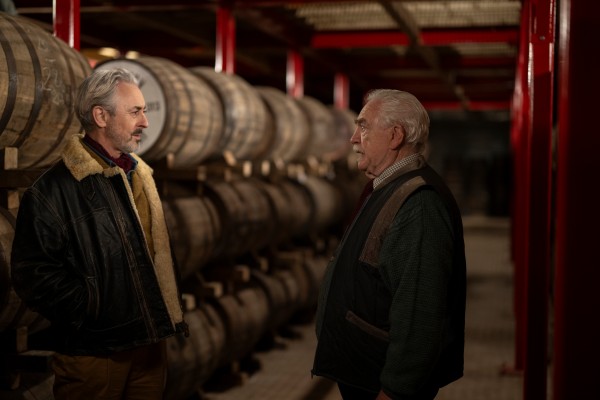
Glenrothan is Cox’s directorial debut. Donal Nairn (Alan Cumming) is a Scotsman who has been away from home for forty years. When his brother Sandy (Brian Cox) writes to tell him he is ill, Donal initially ignores the letter. However, when his club burns down and his daughter Amy (Alexandra Shipp) finds the letter, she persuades Donal to return home. The club is waiting on an insurance payout, removing the last remaining excuse to stay in Chicago. And so Donal makes the trip back home where Sandy runs the two hundred year old, family-owned, whisky distillery.
However, this is not a warm and fuzzy family reunion. The movie examines familial estrangement from a neutral standpoint, showing the audience that it is not as straightforward as it seems.
Society tends to blame adult children for estrangement but forgets that with such a high value placed on a happy family unit, no child would willingly remove themselves from the nucleus. Choosing estrangement also risks collateral damage to sibling and community relationships. As such, the decision to leave is often made over an extended period of thought and consideration.
The film portrays this complexity without overtly spelling out Donal’s troubled history. We understand why he has spent forty years away from Glenrothan. As Donal tries to reacquaint himself with his hometown, random things trigger traumatic memories which reinforce his argument for remaining estranged. A tour of the distillery, for example, reminds Donal that despite his talent and passion for distilling, his father was still caustic towards his efforts.
Similarly, we see Cox’s Sandy navigate a difficult position. He clearly has a deep affection for his brother, preserving his room and maintaining his much-loved motorbike. Yet, he chooses to respect his brother’s wish to cut himself off. Even though Donal was widely known to have a better nose for whisky, Sandy takes over the business, out of duty to his family’s legacy.
When Donal returns, Sandy treads lightly. Even though he has every reason to be resentful, he is sensitive to Donal’s feelings. This is a character who is so full of love, welcoming Donal’s daughter and granddaughter to Glenrothan in the years prior to Donal’s return.
While Sandy’s ill-health may be one of the reasons that Donal returns home, there is a selfish, financially driven motive beneath the visit. However, as aghast as we are when we discover it, our anger is tempered by our understanding of Donal’s underlying trauma.
Cumming’s soulful portrayal of Donal is crucial in this regard. His eyes dance during the lighter, musical moments but turn into voids as we catch him falling into a memory. While this is a man who seems fine, his long-buried burdens are threatening to derail the brothers’ reconciliation.
Despite the challenges, both Sandy and Donal exude a genuine sense of warmth and love for Glenrothan throughout the movie. As you catch the crinkles near Cumming’s eyes, you can see his Donal being reminded of just why he loved his village so much. Similarly, during a celebration for the distillery, Cox delivers a powerful moment as Sandy is visibly moved by the acknowledgment of his sacrifice and the affection everyone has for him. It is easy to convince yourself that these two actors truly love Scotland.
Indeed, Cox calls Glenrothan a love letter to Scotland. Aside from making us wish that we could go to Scotland, it offers both a break from the drama and a reminder of what Donal gave up by moving to America. It is nostalgia-inducing for any Scot who finds themselves away from home.
However, we shouldn’t reduce the movie to just being an ode to Bonnie Scotland. Beyond the lush landscape, Glenrothan is a well-observed reflection on the ties that bind and how it often isn’t a single clean cut that unravels a family. Yet, the movie also instils hope that maybe in the right circumstances, frayed relations can heal, even if imperfectly.
Glenrothan is now showing in cinemas.