
We are extremely privileged in Western Australia to have Asher Fisch as the principal conductor and artistic advisor of the West Australian Symphony Orchestra. An internationally noted interpreter of Wagner, his expertise made the recent performance of The Flying Dutchman an exceptional experience.
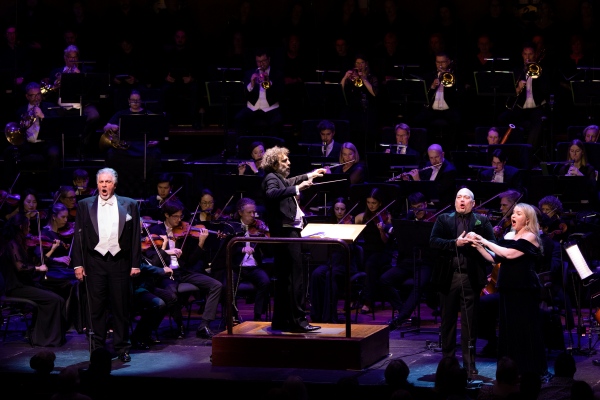
This particular performance was presented in concert form allowing the audience to appreciate the singers and musicians without the distraction of costumes and sets. The historic organ in Winthrop Hall at UWA was bathed in blue light for most of the evening in keeping with the nautical theme and occasionally mingling with red light evoking the mythical sails of the ghostly ship.
The Flying Dutchman (Der Fliegende Holländer, WWV 63) is a German-language opera written and composed by Richard Wagner in 1840-1841. It premièred in Dresden in 1843, conducted by Wagner himself, and is considered the first of his canonical mature operas.
The libretto (text) is based upon Heinrich Heine’s 1833 satirical novel which retells the legend of the sea captain cursed to sail the seas for eternity as a punishment for blasphemy. Every seven years he is permitted to come ashore in an attempt to find salvation through a woman who will love him faithfully until death.
British dramatic baritone Christopher Maltman was superb in his role debut as the eponymous Dutchman. It was wonderful to witness him performing in person after seeing him on cinema screens recently in his other season debut, Wotan in Wagner’s epic Ring Cycle (Der Ring des Nibelungen, WWV 86) at the Royal Opera House in London.
Maltman was perfectly matched by Australian Anna-Louise Cole, a leading Wagnerian soprano in the role of Senta, whose unfailing love ultimately leads to the Dutchman’s redemption.
The pathway to love is never smooth sailing so the requisite love triangle is fulfilled by Perth tenor Paul O’Neill as Erik the huntsman. Australian bass-baritone Daniel Sumegi is an internationally renowned Wagnerian specialist and perfectly cast as Daland, an experienced and respected sea captain, and Senta’s father.
Other highlights of the evening were the combined voices of the WASO Chorus and the West Australian Opera Chorus joining WASO on stage. We also loved the signature use of the wind machine throughout the opera.
Asher will return later this year to conduct Beethoven’s Seventh Symphony in August, Tchaikovsky’s Fifth Symphony in September, and Rachmaninoff’s Second Symphony and Mahler’s Ninth Symphony in October. Fans of choral repertoire will not want to miss the WASO Chorus joining WASO again on stage in November for Handel’s Messiah.