
Trigger warning: We are Jeni discusses sexual violence towards minors. Consequently, this review mentions some of this violence and may be distressing for some readers. Please take care.
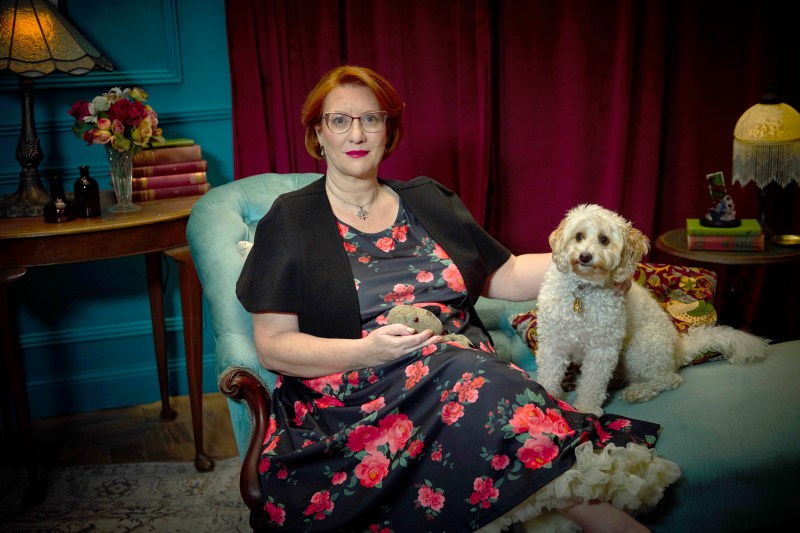
Dr Jeni Haynes has Dissociative Identity Disorder – DID.
DID, previously known as Multiple Personality Disorder, is mental health condition that is borne out of childhood trauma. When a child under the age of eight experiences prolonged and/or recurring abuse, their minds create multi personalities known as alters, to help them deal with the trauma. It manifests when the child’s brain realises that there is no escape; it is a survival tactic.
The abuse that Jeni suffered from was so extreme that she created over 2500 alters to survive. But she didn’t merely survive. She used these personalities to put the perpetrator, her father, behind bars.
We are Jeni charts this journey from victim to victor.
The movie blends multiple storytelling styles. There’s a mix of interviews with Jeni and her alters, archive footage and animation sequences.
It is an eye-opening experience that is both honest yet restrained. The film-makers provide just enough detail to make us sit up and take notice without overloading us with all the graphic details.
This is partially achieved with the use of illustrations to convey some of Jeni’s memories. These work in two ways. They are shields which save us from watching very human reactions to recounting personal trauma. They also remind us that Jeni’s alters are living in the past and are essentially ageless (for now).
The latter point about DID is driven home throughout the movie, particularly where Symphony is involved.
Symphony is the first alter, and creator of all the other alters. We see her in two forms in the movie. When she pops out in real life, the entity known as Jeni is suddenly lighter in tone.
She is only four and this is evident in her language and mannerisms. During one particular retelling about the pattern of abuse they suffered, Symphony stops to fuss over their beloved toy, Sweep.
It is easy to forget that Symphony is four because her voice is coming out of the facade of a fifty year old woman. Additionally, she manages to recount details with such clarity and composure that you question her age.
However, the film makers remind us of her age by including another representation of Symphony – an animated version which mirrors an old photo of Jeni from when she was four. She has wide eyes and a neat auburn bob, and wears a green frock. She looks almost doll-like, which makes hearing about her childhood even more of a horrific experience.
The alters aren’t just permutations of Jeni at different ages.
There’s Muscles, a seventeen year old male who is tough and the epitome of the protective older brother. There’s also Erik, a grown man, whose role was to build the world for all the alters to live in.
It sounds like a fantastical world, opening itself to scepticism. This is probably why mainstream entertainment has had a field day using the condition for their narratives’ desires. However, they have not done the plural community any favours.
Edward Norton’s breakout role, Primal Fear, cast a sinister shadow on multiple personalities. Ditto M Night Shyamalan’s Split.
United States of Tara was so busy creating drama around the alters that they consistently referred to dissociation as “disassociation”. The show also suggested that DID is something that can be supressed by medication and unleashed by the cessation of treatment.
Jeni’s support system were worried that this prevalent impression of someone with DID being the craziest of crazies would result in a failed conviction.
In fact, Jeni’s trial was a landmark case. No one had ever submitted DID as evidence for a crime – even though the technical definition of the disorder states that it is the result of child abuse.
I wish there was more insight into the legal process. There were a few unanswered questions in my mind.
Were the alters’ testimonies the only evidence in court? Was there something else to make these charges a tenable pursuit? Why did it take nearly two years to extradite Jeni’s father?
Legal proceedings aside, I am also curious about the alters in present day. Are they still an active part of Jeni’s life? Or have they retreated into retirement?
However, what the film does deliver fantastically is its core message: DID is NOT an illness.
Dr George Blair-West, Jeni’s psychiatrist is emphatic throughout the movie – DID is an ingenious coping mechanism to help the mind combat trauma from the most heinous of crimes. It is a super power that allows people to vividly recall the very events that triggered DID. This is the secret weapon that sentenced Richard Haynes to a prison cell for the rest of his life.
This is a powerful message for people with DID. Jeni suffered for decades because people did not believe her.
And it is her bravery to not just convict her father but to waive anonymity AND share her story through this documentary that will hopefully save other victims.
We are Jeni is screening at Luna Palace Cinemas on 21st and 22nd March. The screening on 21st March features a special Zoom Q & A with Directors Mariel Thomas & Akhim Dev.