
Songs of the Bulbul opens with voice over narration recounting an ancient Sufi myth about a bulbul (nightingale) captured for its song. Trapped in its cage, it is cloaked in darkness and sings in despair. Eventually, its eyes are removed. The audience collectively gasps as this heartbreaking revelation sets the mood to come…
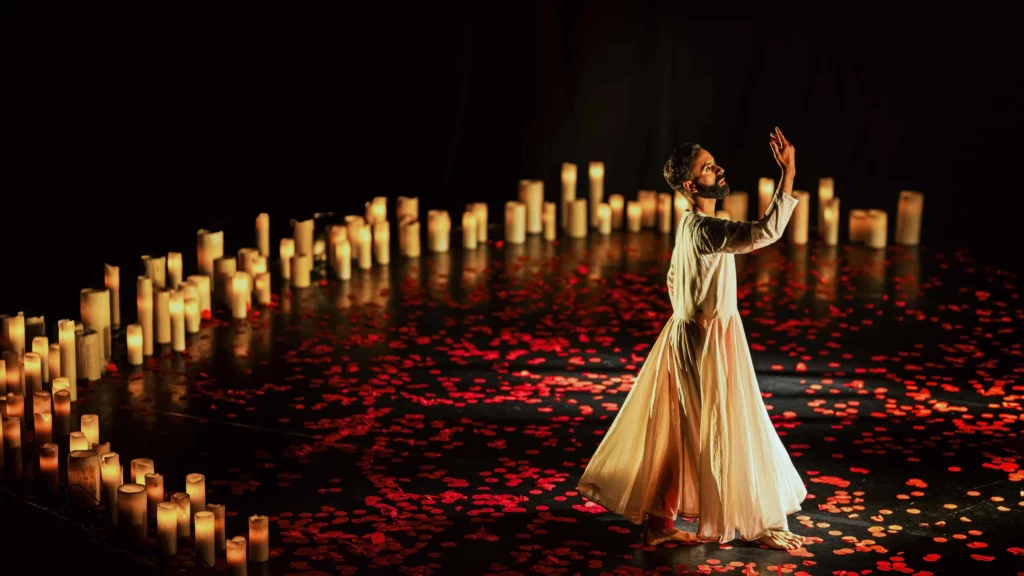
The Bulbul may be known for its beautiful song, but Aakash Odedra has managed to capture its very essence through movement:
From the joy of its birth, to the sorrow of captivity, to the bone-chilling cry of anguish over the loss of its eyes, and finally the bittersweet relief of transcendence into the spiritual realm, free from the confines of the cage. The melding of classical Indian Kathak dance, and modern contemporary by choreographer Rani Khanam lent the dance an ethereal, almost poetic quality.
Emanuele Salamanca’s set was stunningly effective in its simplicity – a handful of hanging bamboo stakes to signify its cage, at one point coming down with an ominous thud signaling the bulbul’s capture. Rose petals floated down from above at different times, painting the stage in swathes of red. (In Persian culture, the bulbul’s song is often addressed to the rose, being symbolic of both earthly beauty as well as spiritual divinity.)
Odedra’s costume, designed by Kanika Thakur – a white flared Anarkali suit made out of floaty, diaphanous fabric – shifted the rose petals on the ground every time he turned, creating mesmerising spirals onstage. Each turn seemed to declare: I am the bulbul, and my movement ripples outward. The red petals were also cleverly used later on in the piece, to signify blood from the bulbul’s eye removal.
Fabiana Piccioli’s lighting design was equally deliberate, carefully curated to emote. Strobe lighting fractured the stage at the moment of the bulbul’s blinding, intensifying the violence of the act, but also served to disorient the audience, as if we, too, were losing our eyesight.
Elsewhere in the piece, multiple candles threw a soft, amber glow onto the stage in a way that felt devotional, or spiritual. And in the final moments of the bulbul’s life, a single speck of light travelled upwards in the darkness, appearing to rise from Odedra’s body – a quiet yet powerful gesture suggesting the bird’s spirit was leaving its cage.
Composer Rushil Ranjan’s score combined orchestral and Indian classical music as well as Sufi poetry seamlessly, creating an otherworldly, spiritual atmosphere. Like the lighting, set and movement, each component felt purposeful to the narrative.
Aakash Odedra Company’s Songs of the Bulbul is a powerful, haunting work, and devastatingly beautiful in its simplicity and restraint. It grips you from its opening, only to release in silence, leaving us to ruminate in the quiet aftermath of loss and transcendence.
I left the theatre altered – not through spectacle, but through something far more spiritual.