
A Parisian atelier is commissioned to create a wedding dress for the Princess of England in this intense, gripping tale of exploitation, abuse and ego.
Three workshops in three different cities come together to form a singular masterpiece fit for royalty: Maison Beliana, a house of haute couture in Paris (the dress), an embroidery workshop in Mumbai (the train), and a lace-making workshop in Alençon, Normandy (the veil).
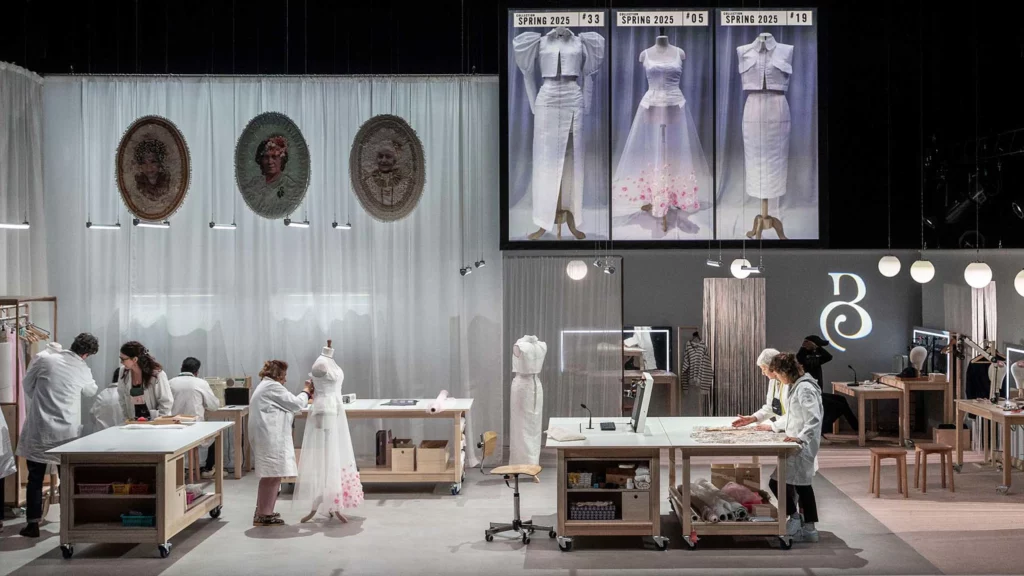
Under the pump to meet not only immovable deadlines, but stringent ethical guidelines, Lacrima follows the very human drama of the craftspeople and the emotional and physical toll they endure.
Central to the storyline is Marion (Maud Le Grevellec), the premier d’atelier of Maison Beliana. Aside from dealing with the stresses of the project, she works with her controlling and insecure husband Julien (Dan Artus) and oblivious mother-in-law, while managing her high-needs teenaged daughter.
The lacemakers of Alençon risk their eyesight to work with the miniscule stitches of their craft. Most importantly, we meet the ageing embroiderer in Mumbai, Abdul Gani (Charles Vinoth Irudhayaraj), whom we see single-handedly threading each of the 230,000 precious pearls on the four metre long train – long after all the other craftspeople have gone to sleep, and undoubtedly at only a fraction of the others’ recompense.
Written and directed by Caroline Guiela Nguyen, Lacrima is a magnificent tour de force of stagecraft and storytelling.
With Alice Duchange’s sleek, clever set design, one stage becomes a series of interconnected workspaces, shifting seamlessly between Paris, Mumbai, and Alençon, and allowing scenes to overlap and unfold simultaneously. Projected on screen overhead, and through the use of webcams on stage, the audience experiences global connections via Zoom calls and split screens.
Though the runtime is 2 hours 55 min, with only a 3 min break with strict instructions to DO NOT LEAVE THE ROOM, I was captivated from start to finish, mouth agog throughout the entire performance. Performed over for languages, French, English, Tamil and Langue de Signes Française (French sign language), with English surtitles projected on screen. The result, which may be confusing to some, felt more immersive to me – emphasising the global nature of the project.
Lacrima, in Latin, means tears, which interlaces into the overarching theme of eyes – the toll on the eyesight of the lacemakers, and the embroiderer, Abdul Gani; the emotional cost and subsequent tears shed within the play; and, perhaps, even an allusion to the pearls embroidered onto the train of the dress, widely associated with tears in mythology. But most important of all is the selective blindness by various people and governing bodies in Lacrima – the mother-in-law’s refusal to see her son’s abusive nature despite Marion’s plea for help; willful ignorance of the institutions that demand ethical compliance while quietly benefiting from exploitation; and the audience’s own complicity in admiring beauty without interrogating its cost.
At its core, Lacrima is more than just a story about a dress. It is a social commentary on the personal choices we make, and the impact on those left behind. It asks not only who creates beauty, but who is damaged in its making – and who chooses not to look.