
I am a big fan of unpredictability, where comedy is concerned. Yes, sets are entertaining but improv and crowd work always catch my attention.
However, I have to admit that when it comes to the latter category, I’m a mid-range guest. I much prefer to watch the shenanigans unfold but given the right circumstance, I can be convinced to join the fun.
So when I realised that I was going to be watching The Unhelpful Therapist in The Regal’s Chorus Room instead of the theatre… I was slightly apprehensive. A smaller room means a higher probability of being a target.
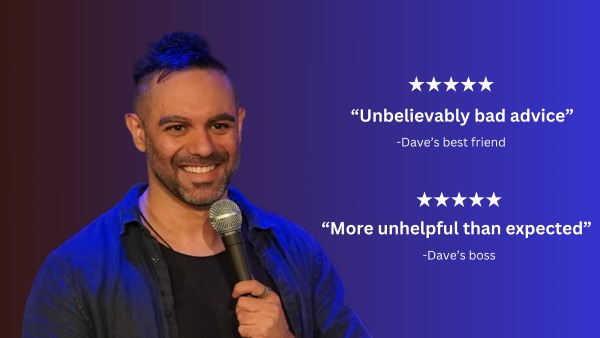
However, David Crisante clearly has experience dealing with burdened guests. His demeanour is calm, gentle and good humoured. I could genuinely see him as a friend in need who could handle the fragile state of someone post breakup.
The process of finding problems to solve starts innocuously. Crisante gives everyone a short form to fill out with a name (pseudonyms are fine), their problem and what level of pettiness they’d like the response to be. After he collects the problems, he reads them out and the audience votes on which one we’re all solving. Then comes the kicker – the winning problem will join him on stage.
Here’s where the pesky crowd element complicates things. Crowd work is a double edged sword. With the right crowd, the chemistry can create a raucous show. Even the most skilled comedian will have trouble churning laughs out of a tight lipped crowd.
Unfortunately, the format of The Unhelpful Therapist makes it more vulnerable to the perils of crowd work.
In a reticent crowd, audience members gain the confidence to pour everything out on paper. The expectation of remaining anonymous, when quashed, feels like an ambush. Understandably, meek guests end up with stage fright.
Case in point: during the session I attended, one guest was a no show while two seemed hesitant to elaborate on their situations.
To his credit, Crisante makes it clear when he reveals the onstage element. You don’t have to come up if you are not comfortable. Similarly, he promises to be gentle, and true to his word, he never mocks his onstage partner.
However, the late disclaimer does affect the vibe and the flow of the show.
Our show started with two less eager audience members, which meant the tone was not perfectly set up. If it had started with one of the last two audience members, who were much more outgoing, it would have whet people’s appetites for petty chaos.
In keeping with Crisante’s more genial, supportive style, he should consider adding a question on his form to ask people if they would be comfortable coming on stage. This way, he could quickly sift through the problems and control the vibe of the event. Alternatively, he should lay out the entire process at the start, complete with the assurance that he will not roast people.
At this juncture, you might be thinking, surely this level of preparation and warning defeats the spontaneity of crowd work?
Normally, I would agree. When you attend a show with crowd work, you risk being picked on. If you’re lucky, you’ll get a comic who can read the room. If you aren’t, you prepare yourself with giveaway lines that you don’t mind getting made fun of.
However, The Unhelpful Therapist takes it to a more personal level by digging deep and putting people on display. Consequently, more care must be taken – which is why despite Crisante’s carefully crafted persona, the show’s process would benefit from refinement.
Still, it is an entertaining night out despite the variables that could derail the show. There is something cathartic about brainstorming evil solutions to random grievances. I’d certainly re-attend The Unhelpful Therapist the next time it’s in Perth.
The Unhelpful Therapist has finished its run at Perth Comedy Festival – check out the rest of the program here.