
⭐️⭐️⭐️⭐️⭐️
If you like your cabaret unpredictable, clever, and genuinely impressive, Cabaret Time Machine is one you should lock into your Fringe calendar.
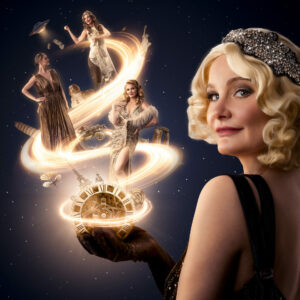
From the moment you arrive, it is clear this is not a sit-back-and-watch kind of show, but it is also refreshingly low-pressure.
While audience participation is a key part of Cabaret Time Machine, the MC makes a point of reassuring the crowd that no one is forced to be involved.
Isabella is wonderfully intuitive, reading the room and picking up on people’s energy, and if someone is not keen to participate, she simply moves on without fuss. It creates a relaxed, welcoming atmosphere where even the shyest audience members can enjoy the show without anxiety. It would be a travesty to miss out on something this good just because you prefer to watch rather than take part.
As you enter the venue, you are given a QR code and invited to vote on the historic era that will shape the entire performance. On our night, the options ranged from Ancient Greece and Renaissance Italy to Marie Antoinette, the Wild West, Elizabethan England and the Swinging Sixties. I personally voted for Elizabethan England, largely out of curiosity about just how bizarre that might turn out, but democracy prevailed and the Swinging Sixties won.
And this is where Cabaret Time Machine really surprises you.
You might assume that a chosen era means themed songs or a nostalgic cabaret playlist. That is not what this show is. Instead, musical improviser Isabella Valette, joined by a pianist and drummer, creates an entire story from scratch. Every lyric, melody, rhythm and beat is made up live on the spot. There is no script, no rehearsal, and no safety net.
What makes it truly clever is that this is not just a collection of funny songs. Isabella builds a full narrative that weaves its way through the entire night. Songs connect with each other. Ideas return later as callbacks. Early jokes quietly become plot points. References to the chosen era are threaded throughout in a way that feels intentional and cohesive rather than random. It is structured storytelling disguised as chaos, and it works beautifully.
The musicality is outstanding. The musicians shift tone and tempo effortlessly, using beats to create suspense, momentum and emotional payoff. At times, the music aligns so perfectly with the lyrics that it feels like a well-rehearsed piece rather than something invented in real time. Watching that level of collaboration unfold live is genuinely impressive.
Isabella’s voice is fabulous, but it is her lyrical intelligence that really stands out. Her rhymes are sharp, inventive and consistently funny. One moment that has stayed with me was during a song referencing her character’s own birth, where she casually landed on the word ablation at the end of a lyric. It was unexpected, clever, and a clear reminder of just how strong her command of language is. At times, you could even see the musicians behind her glance at each other with a slightly quizzical “where on earth is this going” expression, yet they followed her musically and rhythmically without missing a literal beat. It spoke to exceptional skill and a true mastery of the performer dynamic. This is not surface-level wordplay. It is thoughtful, nuanced, and delivered with ease.
One of the most endearing elements of the performance was watching Isabella occasionally catch herself giggling mid-song. As she worked through a lyric, you could see the moment she realised where the song was about to go next, and she would start laughing before the punchline even landed. It was a small detail, but incredibly telling. She was clearly several steps ahead of the audience, constructing the next turn in real time, and that anticipation made the payoff even funnier.
There is something genuinely magical about seeing a performer enjoying themselves that much in the middle of a performance. Those moments pulled the audience in even further, because if she was amusing herself, you knew something very clever or very funny was just around the corner. It made the experience feel warm, confident and shared, rather than performed at the audience.
What also becomes clear very quickly is that this is not a loosely thrown-together Fringe concept. This is not a show dreamed up in someone’s bedroom after a few bottles of wine. Cabaret Time Machine is deeply considered, even while being completely spontaneous. The structure, the callbacks, the musical choices and the linguistic precision all point to a performer who knows exactly what she is doing. The show could pivot in any direction at any point, yet it always feels grounded and expertly steered.
What really sets Cabaret Time Machine apart is that it is not just cabaret.
It is musical theatre with a clear storyline, it is an incredible live musical performance, it is sharp comedy, and it is high-level improvisation, all wrapped up into one cohesive, intelligent experience. Each element supports the others rather than competing for attention, resulting in a show that feels complete, generous and remarkably assured. It is ambitious without being chaotic, and playful without ever losing control.
By the end of the night, the biggest takeaway is how rewatchable this show is. The era depends entirely on the crowd, and that unpredictability is part of the magic. I left wishing the audience had chosen something like Elizabethan England, not out of disappointment, but because I now desperately want to see how wildly different that version of the show might be.
That alone is a testament to how good Cabaret Time Machine is. It is one of those rare Fringe shows where you can genuinely imagine going back again and again, seeing new eras, new stories and entirely new performances every time.
Funny, intelligent, musically brilliant and endlessly inventive, this is cabaret done right.