
With any reworking of a classic, the results can be polarising. West Australian Opera’s Roméo et Juliette, for me, landed on the “too far” end of the spectrum.
A modernised staging of Charles Gounod’s 1867 French operatic version of Shakespeare’s Romeo and Juliet, WAO’s version, co-produced with State Opera South Australia and Irish National Opera, is directed by London-based opera director Rodula Gaitanou and features sets and costumes by Greek London-based designer takis.
We are first introduced to the concept of the two feuding families when the curtains lift – revealing two configurations of gun-wielding, trenchcoat-wearing henchmen pointing their weapons at one another, while a young girl (young Juliette) and boy (young Roméo) try to push their guns down, only to get the guns turned onto them. The children push trolleys bearing a statue each, which they then proceed to break down. Presumably symbolic of the destruction of House Capulet and House Montague at the hands of their children, the child actors (Oliver O’Toole and Isla Graham) performed brilliantly in their brief but very physical roles.
The masquerade ball hosted by Count Capulet (Christopher Hillier) was an explosion of colour, feathers and gender-bending ensembles. It is also where we see the first of the four central duets Gounod’s work is known for, Ange adorable, where the two main characters meet for the first time, and fall in love faster than you can say “Rosaline who?”.
The cast does a spectacular job of conveying the weighty emotions of this Shakespearean tragedy through their crystal-clear voices. Perth-born tenor Alasdair Kent’s Roméo is fiercely passionate, and counterplayed perfectly by Samantha Clarke’s radiant innocence as Juliette, creating explosive chemistry together. Baritone Benjamin Del Borrello’s charmingly roguish Mercutio stole the show, his unexpected cartwheel on stage stealing the audience’s breath, and perhaps even their hearts. Notable mentions include Christopher Hillier’s Count Capulet, Andrew Foote’s Friar Laurent, Kohsei Gilkes’ hot-headed Tybalt, Fiona Campbell’s Nurse Gertrude, and mezzo-soprano Ruth Burke’s Stéphano.
The West Australian Symphony Orchestra navigated Gounod’s powerful score expertly, helmed by WAO Artistic Director Christopher van Tuinen.
Aesthetically, Bernie Tan-Hayes’ lighting stood out – the lights peeking out of the concrete holes resembling the stars, creating a beautiful effect. Designer takis’ minimalist, industrial-themed set consisting of crumbling concrete and steel wire mesh was well thought out in its transformability between the acts – the modular slabs reconfiguring into Juliette’s balcony, or Friar Laurent’s medicinal plant nursery, and even a (rather uncomfortable) “bed” consisting of a giant concrete slab. However, there was a disjointedness between the classic story, the costumes and this industrial setting that I felt detracted from the storytelling.
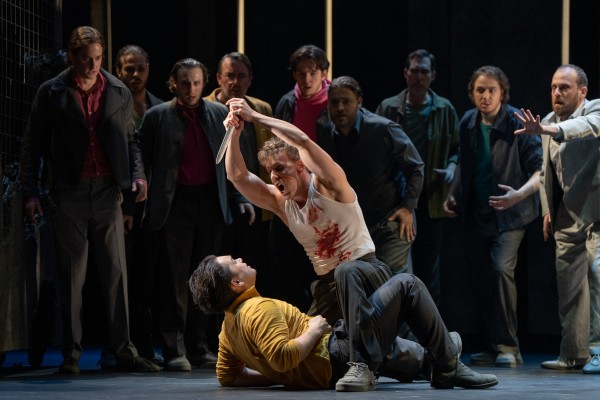
Nowhere was this confusion more apparent than in Act III’s fight scene, where Mercutio and Tybalt get killed with knives – only for henchmen to solemnly arrange guns around their bodies moments later. Talk about bringing guns to a knife fight. It is a baffling, almost comic beat during a moment meant to devastate, and a perfect symbol of the production’s larger problem: the lack of a clear-cut theme. What we got instead was a play on contradictions: 1940s aesthetics mixing with a Mardi Gras affair, industrial construction site vs a lavish party, guns vs knives, classic vs modern.
And yet, for all its contradictions, the story at its heart endures – thanks in no small part to a cast pouring every ounce of talent into it. WAO reminds us why, even four centuries on, we still can’t look away from these star-crossed lovers. Bravo.