
As impressive as the trailer was for Street Fighter, I had my reservations. These were compounded when I watched the 1994 movie, for research purposes. Between Van Damme’s portrayal of an “All-American” military commando with a very un-American European accent and a forgettable storyline, I promptly fell asleep on the couch. At 8pm. I didn’t even bother with the 2009 Street Fighter movie featuring Kristin Kreuk – with a 3% Rotten Tomatoes score, I didn’t consider it a worthwhile investment of my research time.
I was not optimistic. How can a video game with a thin storyline about fighting your way to the top be an engaging movie?
The secret – appeal to the franchise’s fan base.
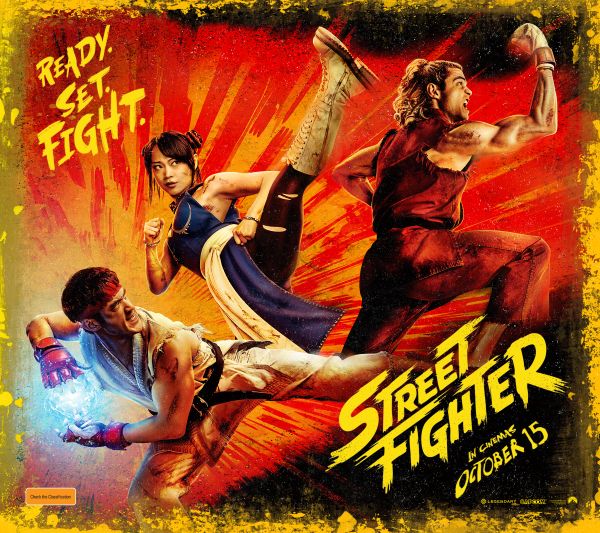
One of the challenges of recreating a combat-focused game like Street Fighter lies in replicating the fight scenes. These aren’t just advanced combinations that actors have to train for – there are supernatural elements such as energy blasts and extreme physical contortions.
This Street Fighter movie has done well on this front. Director Kitao Sakurai has created fight scenes which maximise his actors’ physical prowess and peppered them with the signature special moves of their characters. With the advancement of digital effects, it would be tempting to go hard on the physically impossible moves but by showing restraint, the moves remain special and the movie does not end up resembling AI slop. It was thrilling to see E Honda’s sumo headbutt – a special move which involves him torpedoing into his opponent. And of course, is it really Street Fighter if Ryu doesn’t unleash a Hadouken? The fight sequences alone will satisfy the die-hard fans.
Another big tick for the fandom is the animated flashback scenes – a nice acknowledgment of the franchise’s television history. The hand-drawn, anime-inspired scenes are rich in detail, saturated in colour and heavy on shadows. They evoke a different, mythical world, making them an effective way for the audience to experience the characters’ past. There is a sense of solemnity as we witness Ken and Ryu’s origins.
There are also moments of awe during the high-voltage confrontations between Ryu and Akuma. The 2D sequences allow the movie to break free of the limitations of live-action. The risk of the uncanny valley is diminished and the film can fully depict the explosive battle scenes, stormy elements and foreboding demonic presence included.
According to IndieWire, the animation was meant to be limited to a single scene. Sakurai was so taken by the end result that he requested more animated scenes. This was an inspired pivot that pays off – this iteration of Street Fighter offers a thought-out translation from the arcade to the cinema. You get a sense that Sakurai actually played and loved the game – it wouldn’t be a stretch to imagine his affection for the franchise, seeing how he grew up in the 90s.
However, some elements of the video game did not translate well in this modern adaptation.
Historically, the female characters in Street Fighter were hypersexualised – and this has carried over into this movie. The women are almost exclusively in skimpy outfits. Chun-Li’s cheongsam is adorned with two strategically placed gold circles on the chest as per the source material. While I understand wanting to maintain the authenticity of the signature aesthetics, were gratuitous racy shots necessary?
In one scene, we see Chun-Li, bare backed and partially concealed by steam, walking into a sauna – but there’s no narrative purpose to it. In another scene, there is a deliberate low shot. We only see two characters on screen; however, it looks like it is shot from the POV of a child listening in on a conversation from behind Juli. Is there a reason why her bare thigh and part of her buttock had to frame one side of the screen?
The treatment of the female characters in the movie highlights the challenges of rehashing nostalgia, especially when the stereotypes of the time do not hold up against present standards. How do filmmakers determine what is revived and what is left firmly in the past?
While the moments of objectification are disappointing, I am heartened by how the women are mostly portrayed as capable peers. Cammy is part of Bison’s inner circle and Juli stands out as one of Bison’s more combative soldiers. Chun-Li, in particular, has enjoyed a serious upgrade from Ming-Na Wen’s portrayal in the 1994 movie. Yes, Wen’s Chun-Li was an investigative reporter but aside from giving her a job, Callina Liang’s Chun-Li has a more fleshed out backstory which allows the audience to understand her psyche. She is also a fearsome fighter, participating in action scenes that are as impressive as those involving her male counterparts.
Chun-Li’s history and the insight into Ken and Ryu’s past give Street Fighter a meatier storyline than the 1994 film. However, the main arc is predictable and does not end cleanly. The latter would be fine if we were guaranteed a sequel but at the time of writing, nothing has been confirmed. So if you’re expecting the movie to provide a neatly packaged story, your viewing experience may feel like an assortment of slick visuals and tight fight scenes.
This is a movie for the fans with a deep connection to the franchise – the loose ends matter less than recapturing the essence of the franchise. At its core, Street Fighter is a head-to-head combat game, with little by way of a plot or even in-depth character studies. People are not expecting an Oscar-worthy script – just a storyline with scenes that contribute meaningfully to it. The main draw of the movie is seeing beloved characters brawl and cause collateral damage to their surroundings.
In that regard, Street Fighter is an entertaining watch, especially if you love good fight choreography. While the plot is basic, it paves the way for a potential sequel to explore other directions. I’m grateful I didn’t fall asleep in this one. In fact, I might rewatch it to try to catch all the Easter eggs.
Street Fighter is now showing at cinemas nationwide.