
Road Trip movies have so much potential for comedy gold. You only have to imagine your own family in a four hour car ride to imagine everything that could go wrong but would be absolutely hilarious to watch on the big screen, especially when exaggerated for comic effect. The most common characters are families or a group of young (and potentially inebriated) friends going on the holiday or adventure of a lifetime.
What I would not expect is three elderly nuns and a ten year old boy on a mission to save a convent. While this scenario may be atypical of the standard road trip movie, it provides just the right amount of comedic chaos to make Holy Days an unforgettable trip.
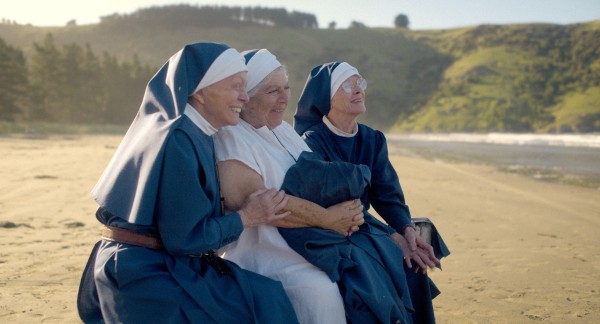
Based on the novel by Dame Joy Cowley, Holy Days is director Natalie Boltt’s first feature film and it is a remarkable outing. It captures the hijinks of a road trip with oddly matched characters while pulling on the heart strings with succinctly timed emotional beats.
We’re transported to 1970s New Zealand. Brian, a young boy (approximately ten years old) is struggling with the death of his mum. Even though his mother has passed a few years prior, he still yearns for her and cannot accept Liz, his dad’s understanding and genuinely lovely partner, as a potential stepmother.
Consequently, Brian has been “acting out” and regularly goes to the town’s convent to seek penance. We soon catch on that his misdemeanours aren’t necessarily just him acting out against his family but possibly his way to rebel against the helplessness he feels while seeking comfort and connection with the three nuns who reside at the convent.
After a long history of taking care of the town’s youngest residents, the nuns of the near-desolate convent see Brian as a spark of joy to their dreary days. Even his punishments of cleaning the floor turn into a game of floorboard skating, with Sister Mary Clare competing alongside him.
The chemistry between the four main characters is beautiful to watch. Mother Superior Sister Agnes (Judy Davis) is the leader of the group – while she is stately and domineering, unlike the stereotypical Mother Superior figure, she is not unyielding. She is only as strict as required and counsels Brian without necessarily reprimanding him. Sister Mary Clare (Jacki Weaver) is the middle ground, offering guidance and connection to our lost protagonist. Her fun-loving nature is infectious and draws the other characters into her orbit.
My favourite character though is Sister Luke (Miriam Margolyes), who I suspect, has always been a batty character with a wicked sense of humour. However, she’s also suffering from what appears to be early onset dementia. Sister Luke is mostly lucid throughout the film – when she isn’t these moments are mainly reframed as comic relief. While one could argue that Boltt is not taking dementia seriously in this film, I think Margolyes’ portrayal is respectful of both the condition and the tone of the movie. Boltt has done a great job of setting up Sister Luke’s eccentricity: she is oddly fixated on her garden, she reacts to situations in unconventional ways and has a laugh for almost every circumstance. So even though we know that she has dementia, there are only a couple of moments where we could definitively say she’s lost her lucidity. For example – did she blurt out an irrelevant verse from the Bible to break the tension or did she do it, unaware of the situation the group were in?
In addition to this, Sister Luke’s condition is never mocked or treated with contempt. In fact, one of the reasons why the group is so determined to make their trek is to save Sister Luke from a future at Nazareth Place – an institution that’s notorious for mistreating its residents.
The genuine affection between the four characters isn’t purely by design. It is also backed by the acting chops of the four players. We have three esteemed actresses, each with their own accolades under their belts, delivering well-crafted performances. Newcomer Elijah Tamati shows great talent in his portrayal of Brian, maintaining a youthful optimism and playfulness while fully conveying his trepidation and uncertainty over the trauma of losing his mum and his anger over her being replaced.
So when Brian finds out that the Bishop is selling the land to developers and rehoming the sisters, it makes sense that the four characters would embark on a quest to save the convent. Brian would do anything to help the three ladies, especially if it involves leaving his stressful home situation.
And so begins their journey to the South Island of New Zealand, to seek counsel from Patricia, a trusted former colleague. As suggested, the trip is fraught with mishaps – from half-blind Sister Agnes’ terrible driving, Sister Luke’s constant need to piddle and flocks of sheep blocking the road.
However, I didn’t expect that this movie would balance these moments of hilarity with pauses for gravitas. One standout scene was at the beach, where Sister Mary Clare tells Brian about her upbringing, as a child who was removed from her family. As she builds up her origin story, you can see it slowly register on Brian’s face – that they have something in common after all and that he is lucky that he has a family. However, before we see him further ruminate on his situation, Sister Luke enters to reinstate the chaos and make us all laugh.
There are a few of these emotionally charged moments during the pitstops. However, the bulk of them come during the midpoint of the trip where the group stay with Patricia while they sort out their options before heading home. It is during this midpoint that Patricia, Brian’s biological great aunt, helps provide the answers that Brian is looking for.
This mid-point change of scenery does heavy work – it stops the movie from being a complete bombardment of ridiculously funny moments. We get a meaningful break to untangle what Brian is going through, and when the time comes for the group to leave, we aren’t just praying they’ll save the convent in time – we’re hopeful for Brian’s family.
And this is why Holy Days is such a special addition to the road trip movie genre. It reminds us that even in grief, we can still pursue adventure. In fact, maybe a little adventure is exactly what we need to kickstart the healing journey.
Holy Days is now showing in theatres.